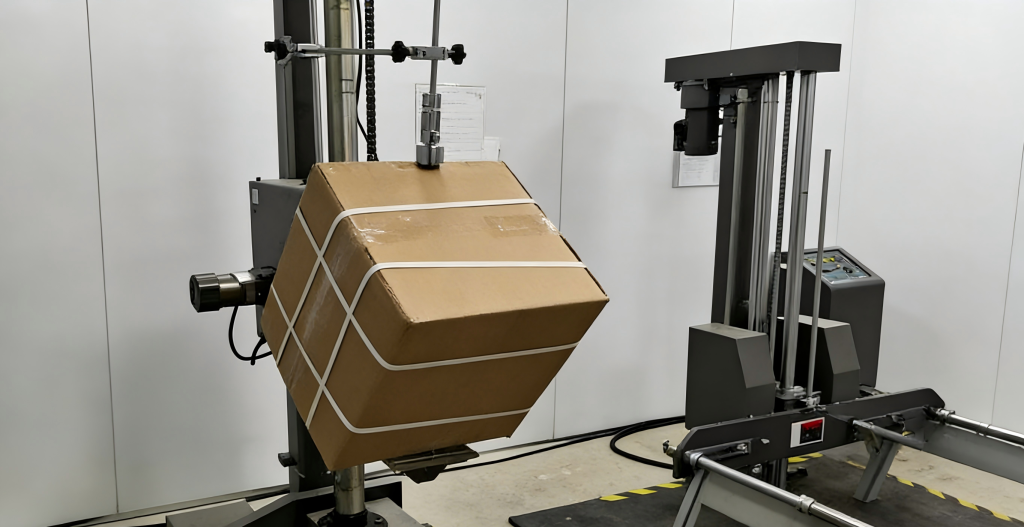
In product circulation, transportation is crucial, and product transportation safety directly impacts quality, customer satisfaction and brand reputation. As a core packaging and product protection reliability test, package drop test simulates accidental drops, collisions and impacts during loading, unloading and transportation. Its core purpose is to verify packaging material and structural protection, identify damage risks from improper packaging, and ensure products reach customers intact.
Package drop test must follow clear standards and scientific processes. Before testing, clarify basis and core indicators, and determine key parameters (drop height, direction, times, environment, judgment criteria) based on product characteristics, transportation mode, industry standards and customer needs. For example, fragile products like lamps need higher drop height or more drops. Common directions (face, edge, corner drop) simulate different actual impact scenarios.
Pre-test preparation ensures test accuracy. Select representative samples consistent with mass-produced products and packaging to avoid result deviation. Check and calibrate professional drop testers to ensure parameter compliance. Maintain stable test environment by controlling temperature, humidity and ground flatness to avoid affecting results.
Test implementation must follow preset plans and specifications. Fix samples on the tester in normal packaging, then perform drops as required. After each drop, carefully inspect packaging (deformation, cracks) and products (functional failure, damage) and record details (parameters, damage status) to form traceable test records.
After testing, systematically analyze data and evaluate packaging performance. If damage occurs, identify root causes (insufficient material strength, unreasonable structure, etc.) and put forward targeted optimization suggestions (replace high-strength materials, add buffer layers, etc.). Optimize packaging schemes and re-test until they meet transportation protection requirements.
Package drop test is valuable throughout product circulation. It helps enterprises avoid transportation damage losses, reduce after-sales complaints and maintain brand trust, while ensuring customers receive intact products. In the current fierce market, standardized drop test has become a key part of enterprise quality control and core competitiveness.
In conclusion, package drop test is the “safety gatekeeper” of product transportation. Enterprises must attach great importance to it, establish standardized procedures, strictly control test links, and continuously optimize packaging based on results to ensure product transportation safety, improve customer satisfaction and lay a foundation for long-term development.
Key Parameters of the ISTA 2A Drop Test
1. Drop Height Determination:
Drop heights are determined based on the package weight
0≤M<10KG 97CM
10≤M<19KG 81CM
19≤M<28KG 66CM
28≤M<45KG 51CM
2. Drop Sequence:
The test requires a specific sequence of drops to simulate real-world impacts on different parts of the package.
- One flat drop on the bottom
- One flat drop on the top
- One flat drop on the left
- One flat drop on the right
- One flat drop on the front
- One flat drop on the rear
- One drop on each of the threebottom corners.
- One drop on thebottom edges

 EN
EN